
Pilot 5
Wildfire insurance enhancing adaptive actions
Pilot lead: AXA Climate
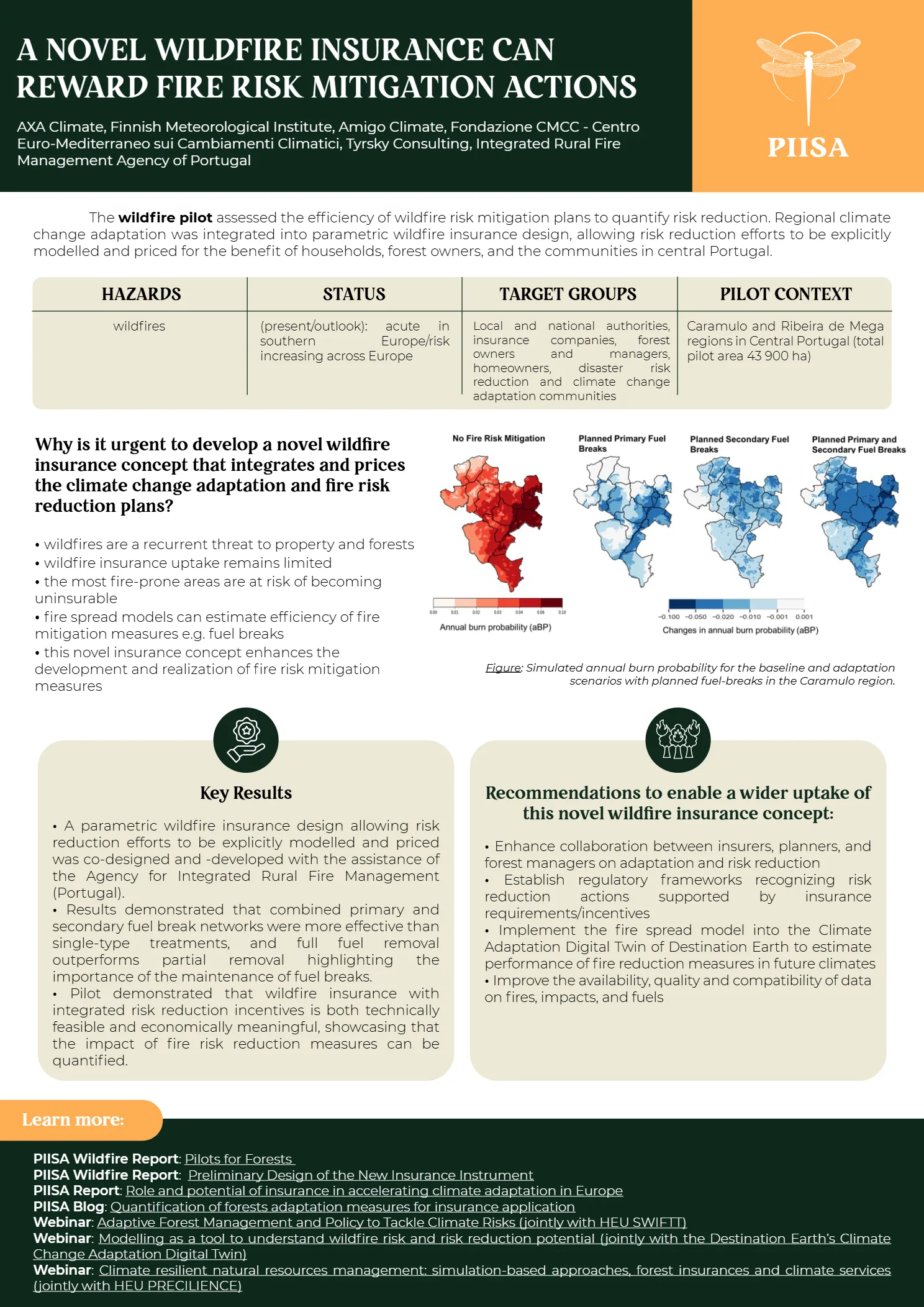
Due to the changing climate, wildfires are increasing both in Europe and worldwide. Portugal is one of the most fire prone regions in Europe which can result in significant damages and casualties; yet only an estimated 10% of wildfire losses between 1990 and 2019 were covered by insurance. The 2017 fire season made the consequences of this protection gap impossible to ignore, when, in a single year, an extraordinarily intense fire season hit Portugal with a recorded total burned area of about 500,000 hectares and more than 120 human casualties. This pilot, led by AXA Climate in partnership with Portugal's Agency for Integrated Rural Fire Management (AGIF), was set up to develop innovative wildfire forest insurances to incentivise adaptation measures at household and forest association levels. To reduce vulnerability to fires, it is crucial to address how insurance mechanisms can promote adaptation measures at different levels, and to engage with public entities in charge of deploying the National Adaptation Plans (NAP).
The pilot focused on the Caramulo and Ribeira de Mega
region of Central Portugal. Two independent fire spread
models – MTT (led by AXA Climate) and WISE (led by the
Finnish Meteorological Institute) - were calibrated
against satellite-based burned area data from 2001 to
2024 and validated against historical fire events,
including the severe 2016 and 2017 Caramulo fires. MTT
reproduced historical fire footprints with 85-92% and
WISE with 40-86 % spatial overlap. Both models produced
more consistent results in areal burn probability under
stochastic fire simulations.
Arealfire danger modelling
under different climate and land-use scenarios will
continue within the
Destination Earth Climate Digital Twin
simulations.
Adaptation scenarios derived from Portugal's
NAP—covering primary fuel breaks (designed to intercept
large fire spreads) and secondary fuel breaks
(protecting settlements and infrastructure)—were
integrated directly into the hazard models and insurance
pricing. Results show that well-maintained fuel breaks
reduce annual burn probability by 30-40%, eventually
translating to indicative premium reductions of
approximately 70-80% for forest and building exposures
deploying primary and secondary fuel breaks. Crucially,
partially maintained or degraded breaks delivered
reductions of only 3-9%, underscoring that premium
discounts must be conditioned on verified maintenance.
This project was conducted in collaboration with and
validated by various stakeholders from local public
authorities and forest associations.
Central Portugal served as the pilot, but the modelling
architecture of this pilot is designed for replication.
Mediterranean regions facing structural wildfire risk —
Southern France, Spain, Greece, Italy — share many of
the same conditions, and could be important locations
for replication, though efforts will be needed for local
calibration and stakeholder engagement.
Infographic
Read more
Tools
Other written outputs
- Blog - Quantification of forests adaptation measures for insurance application
- Info Card - Nature-Based Solutions in the Center of Climate Adaptation