
Pilot 3
Insurance services for agriculture
Pilot lead: BSC CNS
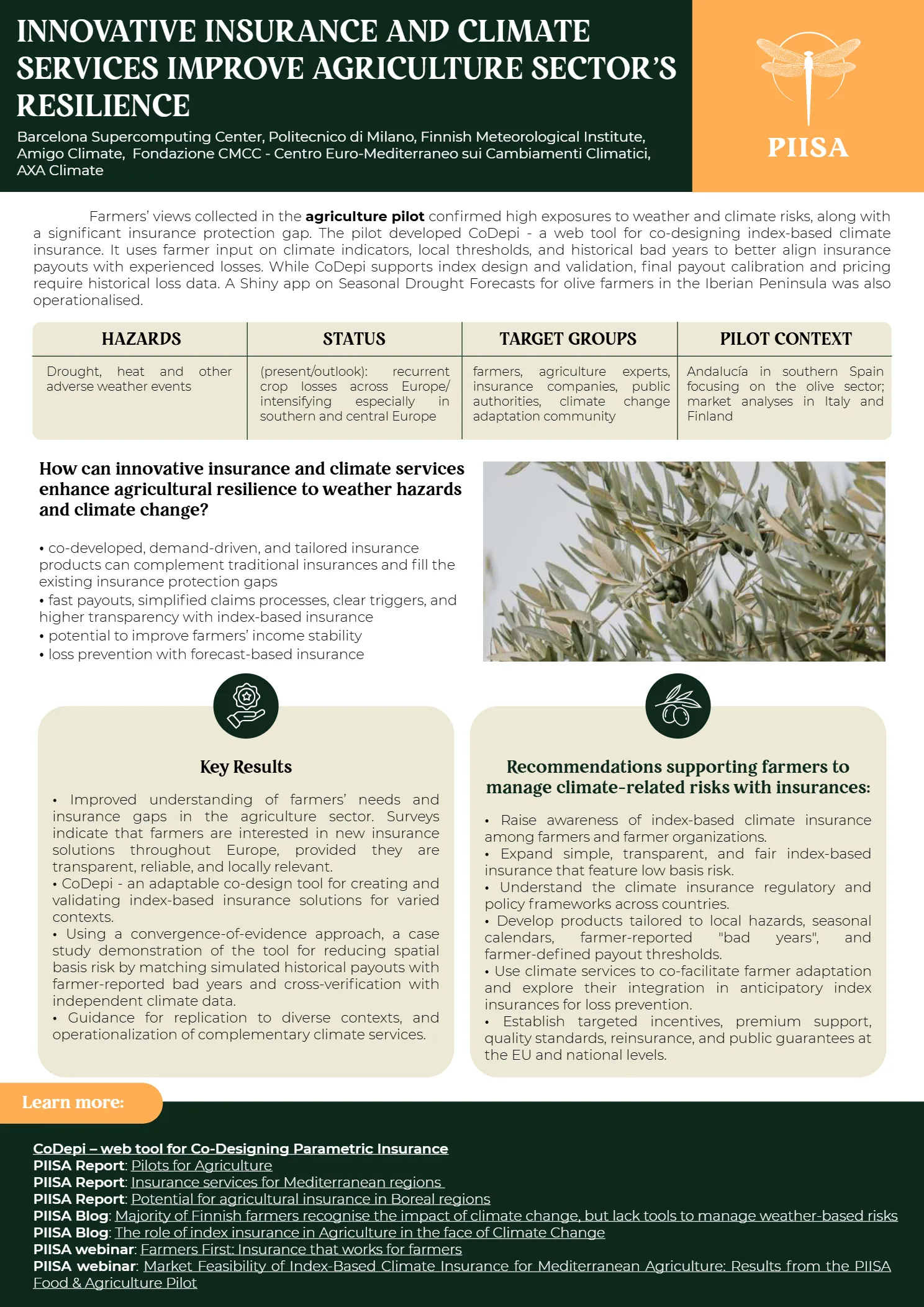
To support adaptation to climate change and variability through improved climate risk management in agriculture, this pilot aimed to co-develop a demand-driven, index-based insurance (IbI, also known as parametric insurance) solution that meets farmers' needs while ensuring viability for insurance providers. The pilot adopted an approach that integrates market analysis, co-design with end users, and the development of complementary climate services, with the objective of demonstrating the potential application of IbI solutions across different European contexts.
In Loop 1, the pilot focused on the Boreal region in
Finland, working in collaboration with the insurance
provider LocalTapiola to assess the market potential and
regulatory landscape for climate and index-based
insurance solutions. This phase found that while the
majority of Finnish farmers recognise the impacts of
climate change, they lack tools to manage
weather-related risks. Although there is interest in
index-based insurance solutions, the current regulatory
framework in Finland does not allow insurers to offer
such products directly, although they may operate as
insurance brokers.
In Loop 2, the pilot expanded to the Mediterranean
region, with market analyses carried out in Spain and
Italy to understand farmer perspectives on climate
risks, existing risk management practices, and insurance
uptake. A case study was conducted in Southern Spain, in
collaboration with the farmer association ASAJA Jaén,
focusing on olive cultivation—a sector highly exposed to
drought and heat-related risks. Through farmer surveys,
participatory workshops, and climate data verification,
the pilot identified locally relevant climate
indicators, thresholds, and contract windows. These
inputs were then used to co-develop an IbI solution
tailored to the case study farm locations, using an
adjustable tool, CoDepi, developed to support the
design, validation, and application of potential
insurance products. The approach emphasised reducing
basis risk, improving transparency, and aligning the
insurance design with farmers' real-world experiences
through a convergence-of-evidence framework.
In Loop 3, the pilot explored the complementary role of
climate services in supporting on-farm adaptation and
decision-making. It operationalised seasonal forecasts
for drought-related indicators in the case study
location, demonstrating how forecasts can provide early
warning and decision support alongside index-based
insurance, while remaining distinct from payout
triggers.
Finally, the pilot assessed the potential for
replicating these solutions across the EU. By combining
insights from both Boreal and Mediterranean contexts,
and by developing transferable tools and methodologies,
the pilot contributes to a broader framework for
implementing novel climate insurance solutions that
enhance agricultural resilience under changing climate
conditions.
Infographic
Deliverables
- D3.7 Potential for agricultural insurance in the Boreal region
- D3.8 Insurance services for the Mediterranean region
- D3.12 Pilots for Agriculture
Tools
- Tool: Co-Depi
- Tool: Shiny App for Seasonal Forecasts
- Three-Month Dry Accumulation Probability Index (DAP150)
- Yield loss drought index
- Standardized Precipitation and Growth Index (SPGI)
- Hail index