
Pilot 2
Addressing gaps in insurance cover for clay shrink swell
Pilot lead: Sustainable Finance Observatory
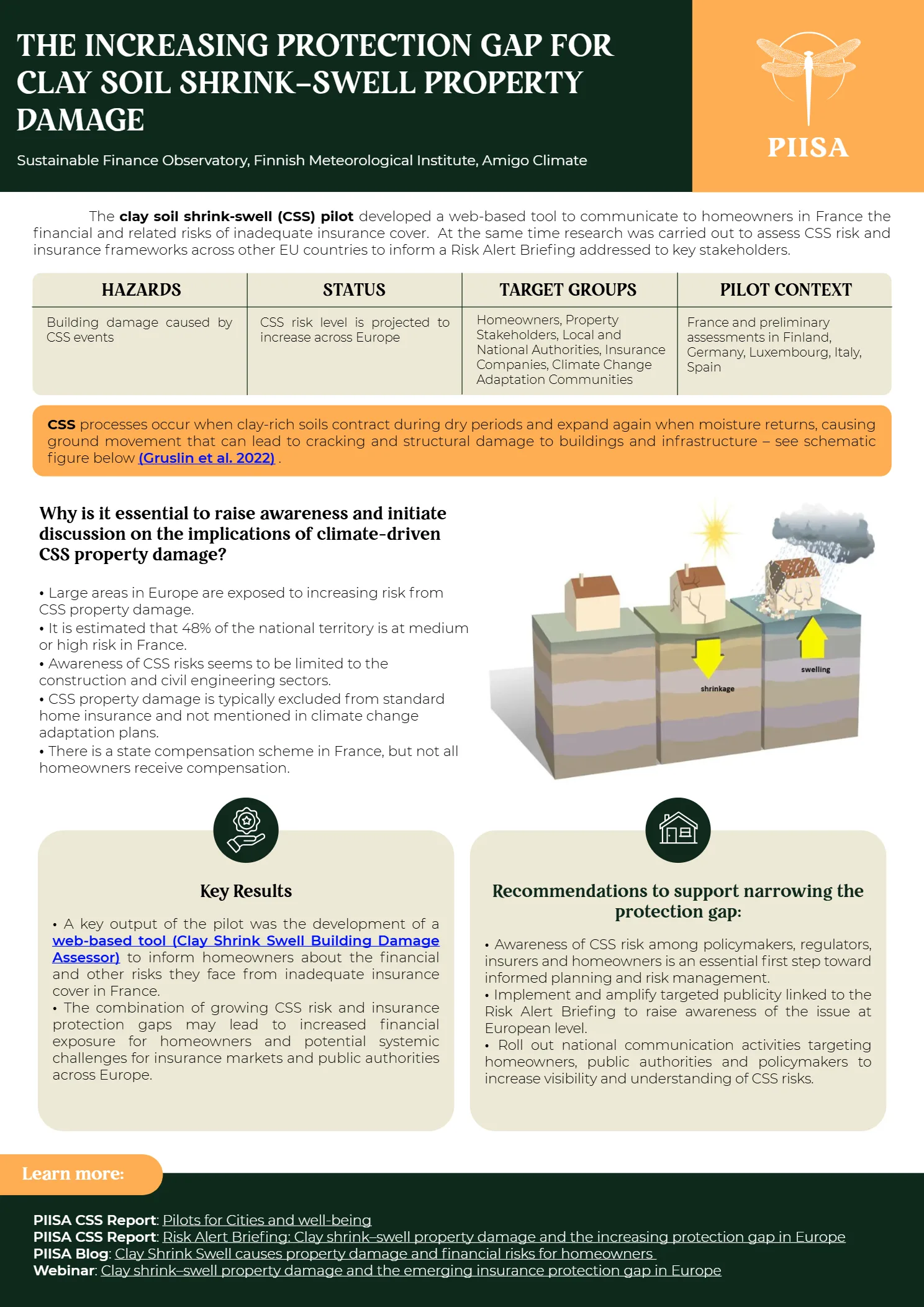
This pilot focusses on the problem of property damage caused by clay shrink swell events and raising homeowner awareness of the potential financial risks associated with inadequate insurance cover. There is currently a significant challenge with a lack of understanding regarding the potential financial implications associated with this hazard. This phenomenon poses a substantial threat for homeowners as the property damage can range from minor cosmetic damage to serious structural issues, often requiring costly repairs. Many areas in Europe have high clay content in the soil and are potentially at risk and the level of risk is projected to increase due to climate change. At the same time there is a clear gap in insurance cover for property damage caused by these events. Our goal was to create an online dashboard that educates and empowers homeowners to manage their financial risks effectively from gaps in insurance cover.
During PIISA, our main objectives were the following:
- Develop a methodology for illustrating the potential financial losses in the event of property damage caused by a clay shrink swell event occurring.
- Design a web dashboard to educate homeowners in relation to their insurance cover that employs the above-mentioned methodology.
- Provide guidance for homeowners on steps they can take to mitigate their risk.
We developed a tool called the Clay Shrink Swell
Building Damage Assessor, or CSSBDA. This is a web-based
tool designed to communicate financial and related risks
to homeowners in a clear and accessible way. The pilot
began with defining the tool's specifications. It was
then developed and tested in the city of Lyon, before
being scaled to the national level in France.
At the same time, additional research was carried out to
assess CSS risk and insurance frameworks across other EU
countries. This research forms the basis of a Risk Alert
Briefing addressed to key stakeholders and designed to
support informed discussion among policymakers,
regulators, insurers and public authorities on the
implications of climate-driven CSS property damage for
housing resilience, insurance markets and climate
adaptation.
Infographic
Deliverables
- D3.11 Pilots for Cities and well-being
- D3.5 Preliminary dashboard specification
- D3.6 Lessons learned from testing usage in Lyon, France
Tools
Other written outputs
- Risk Alert Briefing: Clay shrink swell property damage and the increasing protection gap in Europe
- Blog - Clay Shrink Swell causes property damage and financial risks for homeowners