
Pilot 1
Green roof insurances
Pilot lead: IVM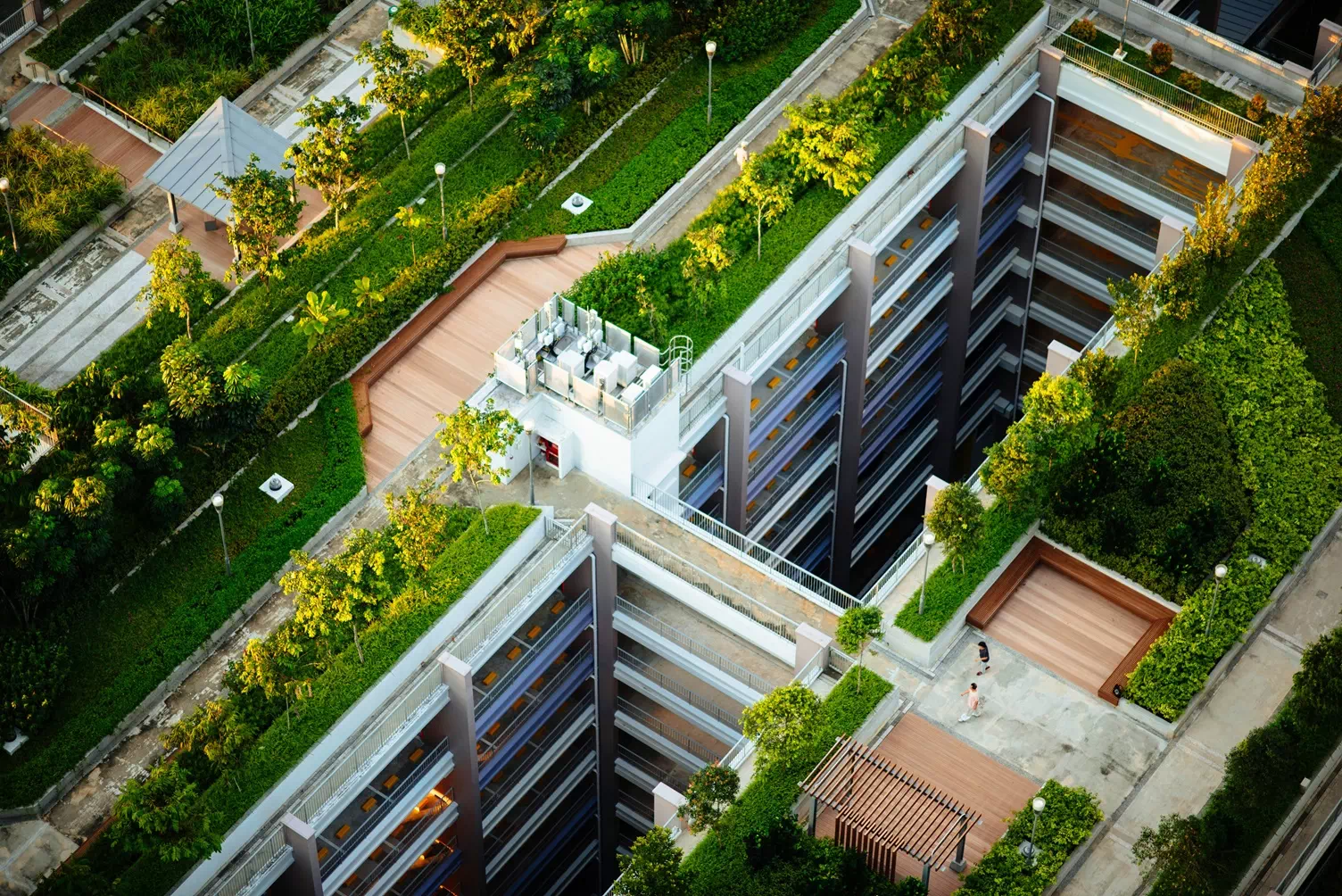
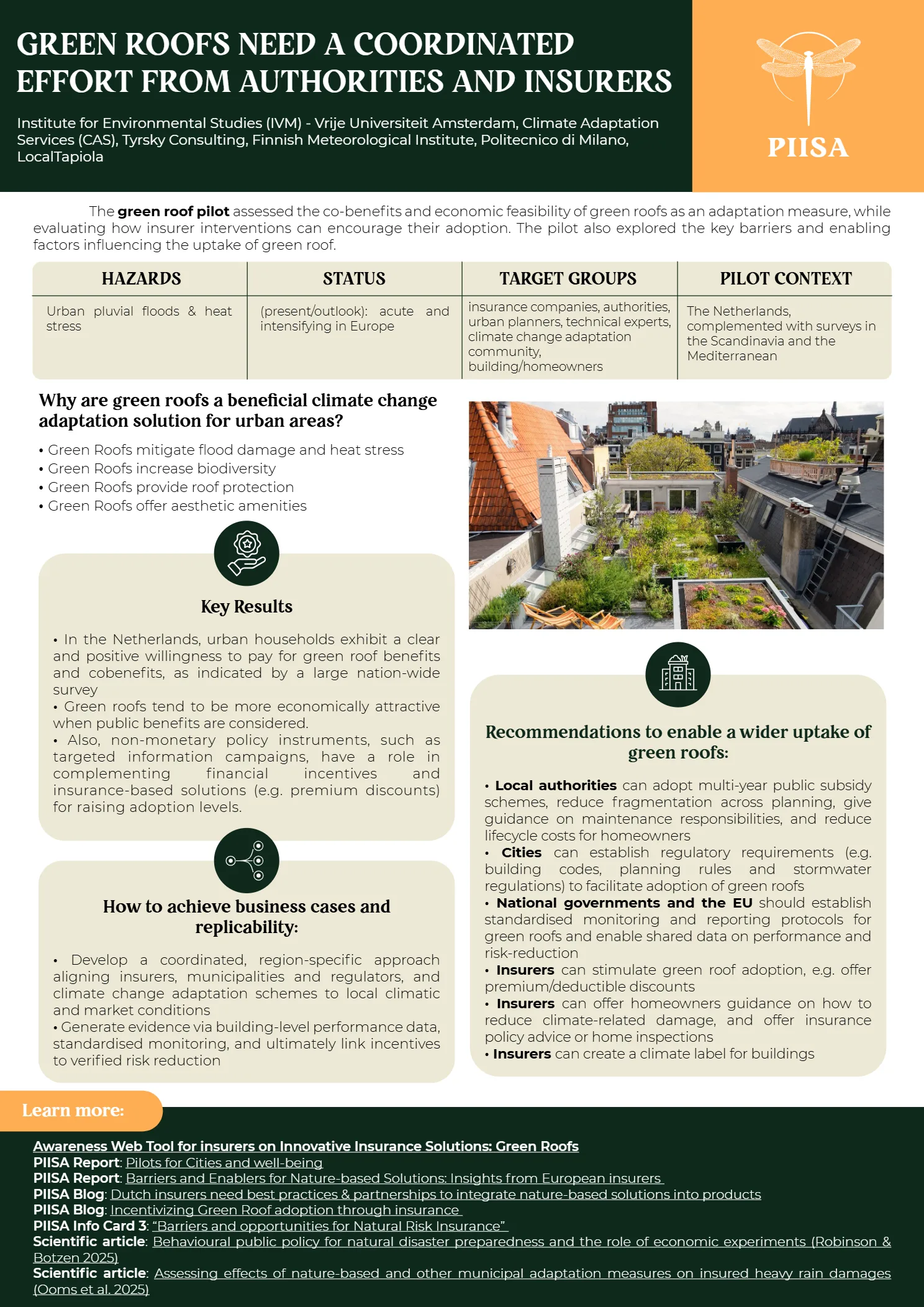
In this pilot, we studied how insurance can stimulate the adoption of urban nature-based solutions, specifically green roofs, with the ultimate goal to work towards the development of a future European business model for insurance that promotes nature-based solutions. The implementation of green roofs is increasing, but still scarce, even though they provide a range of climate change adaptation and mitigation benefits, such as water management or insulation, as well as multiple co-benefits (heat mitigation, biodiversity improvement, amenities, etc.)
The pilot started with cities in the Netherlands. Our
partners IVM and CAS evaluated a climate adaptation
strategy implemented by the Dutch insurer Interpolis,
which aims to encourage policyholders to adopt green
roofs. Furthermore, a broad range of societal benefits
of green roofs have been assessed in surveys that
include discrete choice experiments among a large sample
of urban Dutch residents (N~2000). Based on the assessed
benefits of large-scale green roof adoption, a
cost-benefit analysis has been performed, which results
indicate a positive net economic value generated by
green roofs.
The effectiveness of different insurance solutions to
promote green roofs, in addition to possible enablers
and barriers, has also been examined through surveys and
economic experiments. Results show that mixing public
subsidies with insurance premium discounts and other
information services would be effective in triggering a
larger adoption rate of green roofs in the population.
The pilot also seeks to explore whether similar
approaches can be applied in insurance markets beyond
the Netherlands. During loop 2, we explore the barriers
and enablers of green roofs as an adaptation measure
promoted by insurers in the Nordic region. Results from
the Nordic context highlight that while green roofs are
valued for stormwater management, biodiversity and urban
aesthetics, their benefits are often perceived as
indirect at the individual building scale, weakening the
investment case. Key barriers include technical concerns
such as roof load capacity, snow accumulation and
waterproofing risks, as well as legislative constraints
and uncertainty around maintenance responsibilities.
Enablers identified include stronger regulatory
integration of green roofs into planning frameworks,
improved standardisation and monitoring, and the use of
public demonstration projects to increase awareness and
acceptance.
Finally, the same question is asked in the Mediterranean
region in loop 3. In this context, green roofs are more
strongly framed as climate adaptation infrastructure,
particularly for heat mitigation, indoor thermal comfort
and the creation of usable urban spaces. However,
barriers include concerns over leakage, maintenance
complexity, wildfire risk, and negative perceptions
related to biodiversity (e.g. mosquitos), alongside
lower insurance uptake overall. Enabling factors include
financial incentives, subsidy schemes, and flagship
projects, as well as the development of shared data
platforms and evidence demonstrating long-term
performance and risk reduction benefits at scale.
Infographic
Deliverables
- Final deliverable D3.11 Pilots for cities and wellbeing
- D3.3 Plan for evaluating barriers and enablers for green roof insurances in the Netherlands
- D3.4 Results of survey on applicability in Nordic region
Tools
Other written outputs
- Blog - Incentivizing Green Roof adoption through insurance
- Dutch Insurers: Enablers and Barriers of Nature-based Solutions
- Blog - Dutch insurers need best practices and partnerships to incorporate nature-based solutions into their products
- Info Card - Nature-Based Solutions in the Center of Climate Adaptation